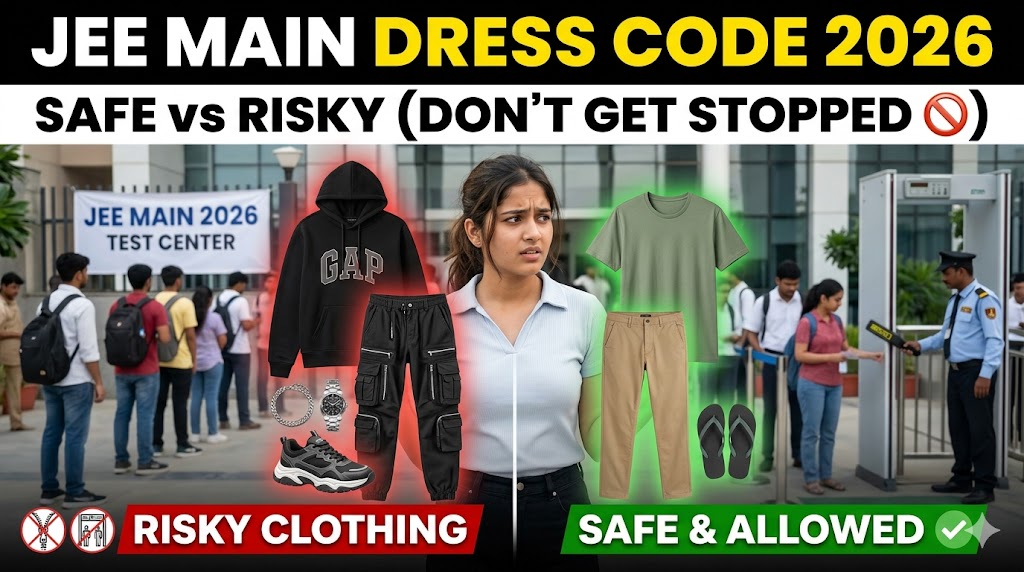
If you’re preparing for JEE Main 2026, one of the most common last-minute stresses is: “Kya pehen ke jaana safe hai?”
Let’s make it very clear: JEE Main has NO official uniform or dress code, but the National Testing Agency (NTA) enforces strict security-based restrictions. You won’t be rejected for your "fashion choice," but you can face significant delays, extra frisking, or even entry issues if your clothing triggers metal detectors or security protocols.
This blog covers real student doubts, the latest 2026 ground reality, and how to choose an outfit that guarantees a stress-free entry.
🧠 The Real Rule: "Safe vs. Risky"
The security check at JEE centres is designed to prevent cheating and hidden electronic devices. Anything that contains metal, looks unusually bulky, or has too many layers will be flagged. The goal isn't to look good; it's to get through the gate as fast as possible.
👖 Lower Body: Pants, Jeans & Joggers
✅ Safe Options: Simple jeans (blue/black), track pants, or plain lowers without metallic zips. Joggers without metallic ends on the drawstrings are also acceptable.
❌ Avoid These: Pants with zippers on pockets are risky as they set off metal detectors. Avoid cargo pants (too many pockets) or jeans with heavy metal studs and chains.
👉 Best Choice: Plain, comfortable track pants with elastic waistbands and zero metallic zips.
👟 Footwear: Shoes vs. Slippers vs. Crocs
This is where 40% of students face issues during frisking.
❌ Risky: Sports shoes with thick soles (5–6 cm) or heavy heels are often flagged. Metal buckles or elaborate designs will lead to extra checking.
✅ Safe: Simple slippers (chappals), flat sandals, or Crocs (provided they are plain and have no metal jibbitz/pins).
👉 Golden Rule: Thin-soled footwear is best. If your sole is unusually thick, be prepared to remove your shoes at the entrance.
👕 Upper Body: T-Shirts, Sleeves & Branding
✔️ Safe: Half-sleeve T-shirts, simple tops, or light shirts. Logos like Coaching-branded T-shirts (e.g., Aakash, Allen) are generally allowed but shouldn't have metallic pins or too many pockets.
⚠️ Risky: Full-sleeve clothing is allowed but "discouraged" as per NTA; you will likely have your sleeves rolled up for inspection. Avoid hoodies or sweatshirts with large graphics, heavy writing, or large pockets.
👉 Winter Strategy: Since the Jan session is cold, wear light layers. Carry a jacket that you can easily remove before reaching the frisking booth.
🧿 Jewellery & Accessories
❌ Avoid Completely: Rings, bracelets, metallic chains, and smartwatches. All electronic gadgets are strictly banned.
⚠️ Conditional: Nose studs or small non-metallic ear studs may be allowed but will be physically inspected. Spectacles with metal frames are permitted after physical verification.
✔️ Allowed: Standard spectacles (even metal frame) are usually no issue after the handheld detector check.
🛕 Religious Items & Ornaments
NTA respects religious sentiments, but security remains a priority.
- ✔️ Allowed: Tulsi kanthi malas, Kadas (specifically for Sikh students), Kirpans, and religious threads (Neck dhagas).
- ⚠️ Condition: You will undergo mandatory extra frisking. If you wear these, you MUST reach the centre at least 1 hour before the gate closing time to avoid last-minute stress.
💇 Grooming & Biometrics
Hair: Both open hair and tied hair are allowed. However, tying your hair with a simple rubber band is a better option as it prevents hair clips from setting off the detector and speeds up neck frisking.
🌿 Mehendi (Henna): This is a major concern. Dark or fresh Mehendi can interfere with biometric fingerprint scanning. If the scanner cannot read your prints, your verification will fail, causing significant delays and potential entry issues.
👉 Best Advice: Avoid applying fresh mehendi on your fingertips 5–7 days before the exam.
🎯 Safe Outfit Checklist
For Boys: Plain half-sleeve T-shirt + Track pants (elastic) + Slippers.
For Girls: Simple half-sleeve Kurti or Top + Leggings + Simple rubber band + Flat sandals.
Frequently Asked Questions (FAQs)
Yes, you can, but it is not recommended. Security staff often roll them up or check them more strictly, which adds unnecessary stress before the paper.
It is risky. NTA guidelines explicitly state that "heavy footwear with thick soles" is not permitted. If you wear them, be ready to leave them outside the exam hall or undergo intensive checking.
Yes, Crocs are generally very safe and comfortable. Just ensure they don't have any metallic charms or "jibbitz" attached to them.
Yes, branded T-shirts from coaching institutes are allowed. Frisking staff will just check to ensure there is no hidden material behind the logos.
Metallic nose studs will trigger the metal detector. If it is permanent and cannot be removed, you must reach the centre early for a manual physical inspection.
It doesn't cause rejection, but if it prevents the biometric machine from reading your fingerprints, you will face huge delays and a manual verification process which is very stressful.
Final Takeaway: Security > Fashion
JEE Main is a test of your knowledge, not your wardrobe. Before leaving your house, just ask yourself: “Will this item slow down my security check?” If the answer is yes, change it.
Focus your energy on the 300 marks, not on the frisking line. Keep it simple, keep it plain, and keep it metal-free.
🚀 Ready for Exam Day?
Don't let manual errors stop your progress. Use our tools to ensure you meet all criteria for the 2026 admissions cycle.
Check Board Eligibility Now → Predict Your College Options →Need Mentorship?
Discover your path: Elevate your studies with Personalized Mentorship. Let's achieve your academic goals together.
College Predictor
Unlock you future: Use our college predictor to find the best fit for your dreams.
Comments
Leave a Comment
Please log in to leave a comment.


Newsletter
GET STARTED WITH MARGDARSHAN
Nurture Your Potential: Empowering Students with Engaging Content and Essential Resources through Our Impactful Newsletter!